China’s Long Road from Struggle to Strength
By Muhammad Mohsin Iqbal
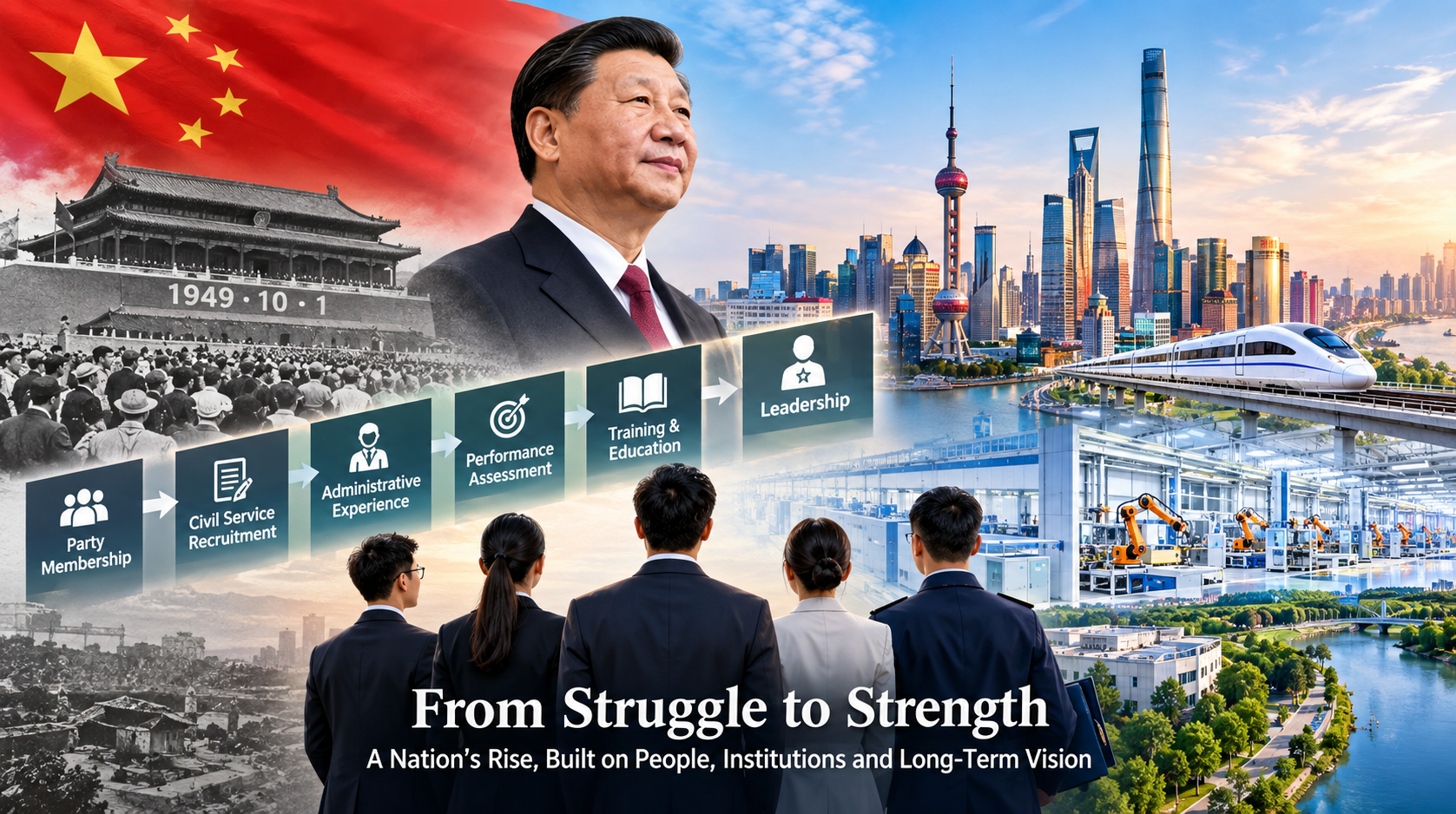
Every year, October 1 carries a special significance for China. It marks the establishment of the People’s Republic of China in 1949 and the beginning of a remarkable chapter in the country’s modern history. Seventy-seven years later, China’s transformation from a poor and war-ravaged country into one of the world’s largest economies and most consequential powers remains one of the defining stories of the modern age.
China’s rise, however, cannot be explained merely by its vast population, natural resources or geographical size. Behind the skyline of Shanghai, the factories of Shenzhen, the high-speed railways crossing the country and the extraordinary expansion of its technological capacity lies something less visible but equally important; a political and administrative system that has placed considerable emphasis on the selection, training and evaluation of officials.
This raises an intriguing question; how does a person in China progress from being an ordinary political worker to occupying a position of national leadership?
The answer is more complicated than the popular story that every aspiring Chinese leader simply passes a “civil service test” and then spends thirty years climbing a predetermined ladder. The reality is a much longer and more intricate process. Entry into the Communist Party has its own formal procedures. Applicants must be recommended, investigated and approved through Party organisations, and those accepted normally undergo a probationary period before becoming full members. The civil-service examination, meanwhile, is a separate mechanism for recruitment into government service.
What distinguishes the Chinese system is therefore not a single examination but the accumulation of experience. Officials may serve at different administrative levels and are assessed on their ability to implement policies, manage institutions and deliver results. Research on China’s cadre system has found that economic performance has historically been an important consideration in advancement, while the criteria have increasingly broadened to include social welfare, poverty reduction, environmental protection and other policy objectives.
This is an important point. In China, political advancement is not normally the consequence of winning a nationwide popular election. Officials are selected and promoted through a hierarchical Party-state system. Their careers depend upon assessments by higher authorities, organisational requirements, political considerations and demonstrated performance. Academic research also cautions against portraying this system as a perfectly mechanical meritocracy: political loyalty, institutional relationships and factional considerations can also influence promotion.
Nevertheless, the emphasis on long-term administrative experience is striking. A cadre may be required to demonstrate competence in one locality before being entrusted with a larger responsibility. Economic development, employment, poverty reduction, public administration, social stability and environmental objectives can all enter the assessment. China has also increasingly recognised that rapid economic growth cannot be the sole measure of good governance. The World Bank has documented the expansion of performance criteria to include social, environmental and innovation outcomes.
The career of Xi Jinping provides an illuminating example of this gradual ascent. Before reaching the highest office, he served for many years in provincial and local positions, including Fujian and Zhejiang. In 2007, following the removal of Shanghai Party Secretary Chen Liangyu amid a major corruption scandal, Xi was appointed to lead Shanghai. His tenure there was brief, but the assignment placed him directly in one of China’s most important political and economic centres. Later that year, he entered the Standing Committee of the Communist Party’s Politburo, marking his arrival at the highest level of national leadership.
Another significant feature of the Chinese model is continuing education. Senior officials are not simply left to rely upon the experience acquired in provincial offices. The Central Party School of the Communist Party of China, now operating together with the National Academy of Governance, serves as a principal institution for educating and training senior and middle-ranking officials. Its programmes cover political theory, governance, national strategy and professional capabilities. The Chinese government revised the regulations governing Party schools in 2025, reaffirming their role in training Party members and officials.
China’s achievements, therefore, should not be reduced to the simplistic proposition that it has advanced because it possesses a flawless system of selecting technocrats. The reality is more complex. China’s development has resulted from a combination of economic reforms, enormous investment, industrial policy, education, infrastructure, international trade, technological advancement and a highly organised state apparatus. Its cadre-management system has been one important component of that larger transformation.
There are also serious debates about the system. Researchers have documented weaknesses, including the possibility that officials may manipulate performance indicators or concentrate excessively on measurable targets. Environmental objectives, for example, have sometimes competed with the traditional emphasis on economic growth.
Yet there is a lesson here that deserves attention beyond political systems and ideological differences. Nations do not become powerful merely because they possess constitutions, institutions or ambitious plans. Institutions become effective when capable people are placed in positions of responsibility, when performance is examined, when experience matters and when public administration is treated as a serious profession.
China’s extraordinary journey since 1949 is ultimately a story of sustained national effort. Its experience demonstrates the enormous consequences that can follow when a state builds institutions capable of pursuing long-term objectives and develops a leadership pipeline through years of administrative experience and training. Other countries need not copy China’s political model to study this lesson. They can draw their own conclusions from it.
The central question for any nation is simple: are positions of authority being treated as rewards for loyalty and connections, or as responsibilities requiring knowledge, experience, integrity and proven performance?
China’s rise has made that question impossible for the rest of the world to ignore.